 |
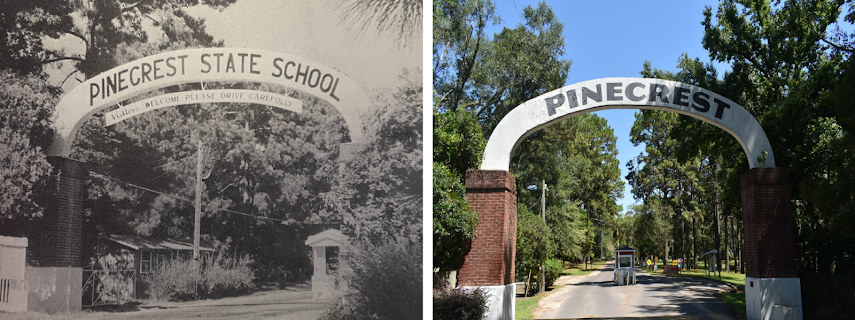
| Pinecrest State School opened in 1921 as a facility for individuals with intellectual disabilities. One hundred years later, it remains in operation as Pinecrest Supports and Services Center, specializing in the treatment of people with comorbid intellectual and developmental disabilities, and complex medical, behavioral and psychiatric support needs. |
In 1884, 129 patients were admitted to East Louisiana
Hospital from the New Orleans Asylum. These individuals would now be what we
refer to as individuals with an intellectual disability. In 1914, the
Superintendent of East Louisiana Hospital recommended the establishment of a
specialized facility for these patients, as the mental health hospital was not
the best place to meet their unique needs. Subsequently, legal authorization
from Legislative Act. No. 141 of 1918 created Pinecrest.
In 1921, 1,000 acres of land was purchased from the
Beauregard Development Company utilizing portions of Camp Beauregard that were
employed during World War I. On December 21, 1921, Pinecrest officially opened
with a total of 37 patients. The total annual budget for 1921 was $50,000.
During these times, the facility was completely self-sufficient with a working
vegetable farm, dairy farm operation, and livestock such as chickens, hogs and
cattle. This was during a time when the only way the facility could operate was
through self-sufficiency due to budget constraints. Years later, additional
funding was given to the agency so they could begin to purchase instead of
produce.
Now known as Pinecrest Supports and Services Center, the facility consists of 947 total acres with 163
acres leased to the Ward 9 recreational facility, giving Pinecrest 784 acres
to care for and operate on. There are 335 total buildings on campus with 158
heated and cooled buildings. There is an on-grounds bakery, greenhouse, canteen, medical observation unit, fully functional dental clinic, park, baseball field, an equine therapy
program, a barn with various animals for pet therapy, swimming pool, gymnasium, and school operated by the Department of Education
which is open year round focusing on the
specific curricula needs for the individuals supported. The Pinecrest school also has a
GED program.
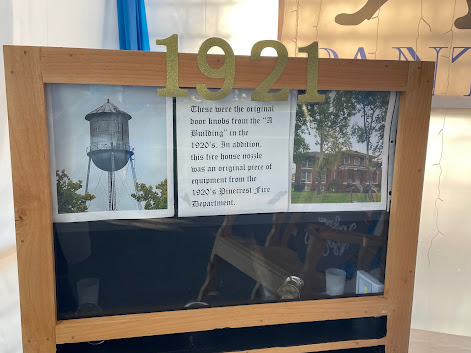 |
| This shadowbox displays the original knobs from the A Building in the 1920s, as well as a fire house nozzle that was an original piece of equipment from the 1920s Pinecrest Fire Department. |
On campus, 40 buildings are currently used as residential
homes. There are 12 day service buildings used for skill acquisition training activities,
active treatment and training, and vocational learning opportunities. Pinecrest
has various work training options including the on-campus canteen, bakery, on-grounds
delivery services, food service skills through the kitchen, landscaping and lawn
care through the greenhouse, contracts with community-based agencies, and many
more job opportunities.
In December 1921, Pinecrest had 37 residents and during the
1970s the facility had more than 2,100 residents. In 2021, Pinecrest supported
430 residents with intellectual disabilities who have significant medical,
behavioral and psychiatric challenges. It also has well over 100 individuals
with autism who receive specialized programs and training for their unique
needs. The facility also has a specialized geriatric
program for individuals with an intellectual disability and their unique issues
associated with aging and dementia. Additionally, it offers a wide array of
clinical services such as psychology, occupation therapy, physical therapy,
speech therapy, medical services, nursing, recreation services, psychiatry and
neurology, among other specialized clinical services needed by the individuals
supported by Pinecrest.
From 37 patients with limited services and a budget of
$50,000, to a complex treatment-based organization, Pinecrest has for 100 years continuously supported individuals with
intellectual and developmental disabilities that many others cannot serve or
refuse to serve over the years. Now, its current focus is on specialized programming
and individualized treatment and skills acquisition training focused on
independence, autonomy, self-advocacy and skills development to increase each
resident’s ability to live independently.
Posting Komentar
Posting Komentar